
diff options
| author | Christian Kolset <christian.kolset@gmail.com> | 2025-09-10 10:44:54 -0600 |
|---|---|---|
| committer | Christian Kolset <christian.kolset@gmail.com> | 2025-09-10 10:57:10 -0600 |
| commit | 9842533cf12a9878535b3539291a527c1511b45c (patch) | |
| tree | b9944a583935687ce98a1c7f76599cd418b2a7b6 /tutorials | |
| parent | 988717825b29901dff1ac22432be1372434badd7 (diff) | |
Added figure in HTML formatting to center figure
Diffstat (limited to 'tutorials')
| -rw-r--r-- | tutorials/module_3/2_roots_optimization.md | 33 |
1 files changed, 28 insertions, 5 deletions
diff --git a/tutorials/module_3/2_roots_optimization.md b/tutorials/module_3/2_roots_optimization.md index cc9dbb5..2c94f92 100644 --- a/tutorials/module_3/2_roots_optimization.md +++ b/tutorials/module_3/2_roots_optimization.md @@ -60,7 +60,7 @@ Let's consider a continuous function $f(x)$ with an unknown root $x_r$ . Using t Once we bisect the interval and found we set the new predicted root to be in the middle. We can then compare the two sections and see if there is a sign change between the bounds. Once the section with the sign change has been identified, we can repeat this process until we near the root. ![[bisection.png|500]] -As you the figure shows, the predicted root $x_r$ get's closer to the actual root each iteration. In theory this is an infinite process that ca3n keep on going. In practice, computer precision may cause error in the result. A work-around to these problems is setting a tolerance for the accuracy. As engineers it is our duty to determine what the allowable deviation is. +As you the figure shows, the predicted root $x_r$ get's closer to the actual root each iteration. In theory this is an infinite process that can keep on going. In practice, computer precision may cause error in the result. A work-around to these problems is setting a tolerance for the accuracy. As engineers it is our duty to determine what the allowable deviation is. So let's take a look at how we can write this in python. ```python @@ -128,16 +128,39 @@ plt.legend() plt.show() ``` # Open Methods -## Modified Secant -We can do better. - +So far we looked at methods that require us to bracket a root before finding it. However, let's think outside of the box and ask ourselves if we can find a root with only 1 guess. Can we improve the our guess by if we have some knowledge of the function itself? ## Newton-Raphson +Possibly the most used root finding method implemented in algorithms is the Newton-Raphson method. Unlike the bracketing methods, we use one guess and the slope of the function to find our next guess. We can represent this graphically below. +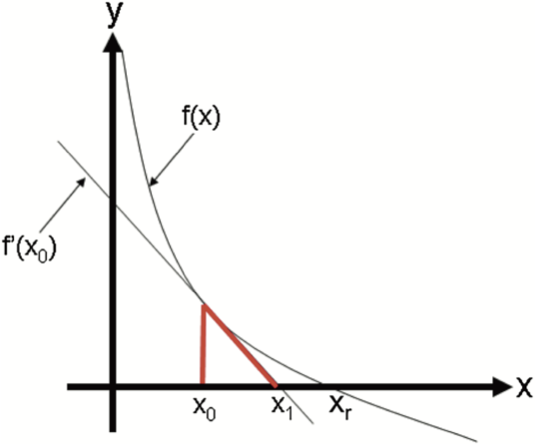 - +<img + style="display: block; + margin-left: auto; + margin-right: auto; + width: 60%;" + src="https://pythonnumericalmethods.studentorg.berkeley.edu/_images/19.04.01-Newton-step.png" + alt="Newton-Raphson illustration"> +If we start with a single + +## Modified Secant +This method uses the finite derivative to guess where the root lies. We can then iterate this guessing process until we're within tolerance. + +$$ +f'(x_i) \simeq \frac{f(x_{i-1})-f(x_i)}{x_{i-1}x_i} +$$ +$$ +x_{x+1} = x_i - \frac{f(x_i)}{f'(x_i)} +$$ +$$ +x_{x+1} = x_i - \frac{f(x_i)(x_{i-1}-x_i)}{f(x_i+\delta x)-f(x_i)} +$$ +$$ +x_{x+1} = x_i - \frac{f(x_i)\delta_x}{f(x_i+\delta x)-f(x_i)} +$$ # Pipe Friction Example |