
diff options
| author | Christian Kolset <christian.kolset@gmail.com> | 2025-04-24 23:31:17 -0600 |
|---|---|---|
| committer | Christian Kolset <christian.kolset@gmail.com> | 2025-04-24 23:31:17 -0600 |
| commit | c98972ced700b6250915a21af4b76459365743f3 (patch) | |
| tree | 87f62caa9dbe5dbb997f12f7e167ff4ddbc91697 /tutorials/module_1/array.md | |
| parent | 342b88e6002fa1eee9b020864d83ddbd79ef3ad9 (diff) | |
Updated markdown files to look better after converting to latex files.
Diffstat (limited to 'tutorials/module_1/array.md')
| -rw-r--r-- | tutorials/module_1/array.md | 2 |
1 files changed, 1 insertions, 1 deletions
diff --git a/tutorials/module_1/array.md b/tutorials/module_1/array.md index 3385231..449135a 100644 --- a/tutorials/module_1/array.md +++ b/tutorials/module_1/array.md @@ -15,7 +15,7 @@ A two-dimensional array would be like a table: A three-dimensional array would be like a set of tables, perhaps stacked as though they were printed on separate pages. If we visualize the position of each element as a position in space. Then we can represent the value of the element as a property. In other words, if we were to analyze the stress concentration of an aluminum block, the property would be stress. - From [Numpy documentation](https://numpy.org/doc/2.2/user/absolute_beginners.html) -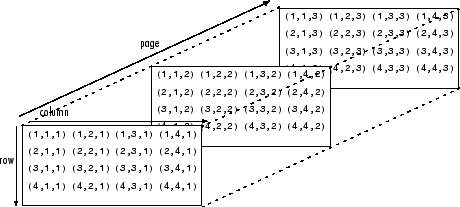 + If the load on this block changes over time, then we may want to add a 4th dimension i.e. additional sets of 3-D arrays for each time increment. As you can see - the more dimensions we add, the more complicated of a problem we have to solve. It is possible to increase the number of dimensions to the n-th order. This course we will not be going beyond dimensional analysis. |